



Saad Husain P.Eng
The construction and fabrication industry in Canada has been looking at creative ways to increase productivity and drive down costs. One of the key focus areas in the last decade has been digital transformation. Like any emerging business area, digital transformation means different things to different industries. The core principles are however the same, which are to utilize technology to enable transformative changes in the business that make the business more productive and more profitable. And with every new journey comes its unique challenges. I am sharing some insights, which you will hopefully find beneficial, from the successes and challenges on my journeys of digitalization, from road mapping, ERP implementations, change management, and continuous improvement.
Start with a clear vision of success
Get early alignment from executive leadership, with a clear scope, budget, and timeline. Have a clear view of the outcomes the senior leadership is expecting from the effort, and related KPIs. These KPIs are critical to final success criteria. This is critical to maintaining strategic alignment on day-to-day decisions, with the end in mind. It is easier to change manage your project, as well as take Go/NoGo decisions at Go Live.
One team – your business team and partners
Build a strong cross functional team of internal leaders, internal SMEs and external consultants to augment the team. Engage implementation partners early in the RFP journey. The implementation partners are the experts, who do this day in day out. Selecting strong implementation partners, who are aligned to your goals will increase your chances of success significantly.
Select a small number of cross functional leaders for review of RFP submissions. Opening the gate too wide will cause challenges, delays in selection process, and may lead to more customized best-of-breed solutions, which are highly complex to integrate during implementation.
Go out of the box – use best practices
Limit modifications and customizations – everything impacts everything in enterprise world. There is no small change. Sticking with out of the box as much as possible ensures things work, and small changes don’t require extensive testing across the systems. In many cases the processes and system configuration are already configured to industry-best practices.
This is a great opportunity to embed these industry best practices into your business.
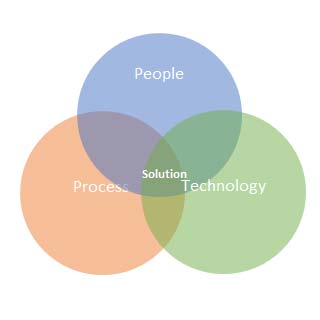
It’s a Tri-Part Engine- People, Process, and Technology
The solution design, business processes, and impact on people must be kept in balance for overall success. Streamline and standardize business processes first before you automate them. Pick the best practices for key business processes. Then make it your standard way of doing business. Leadership from all impacted functions need to stack hands, work as one team, and own the process. Standardized processes are exponentially easier to integrate with enterprise systems and train people. It is important that you are assessing and streamlining people roles and responsibilities alongside business process and the system design. This ensures the design can be executed successfully in your business by the people who will be the final users.
Overcommunicate – internally and externally
 Communication and engagement with business through the program is key to change management. Regular engagement input sessions are required in subject areas to ensure the final build will meet the ever-evolving business requirements. Keeping operational and functional leaderships engaged on key decisions are critical to maintain alignment on the solution design, process changes, and related roles and responsibilities. Without leadership buy-in, it is very hard to gain traction from the business on any changes to process, and adoption of the new systems. Communicate changes to clients, vendors, and partners early so they can dedicate appropriate attention to the changes, to minimize post Go live disruptions.
“Standardized processes are exponentially easier to integrate with enterprise systems and train people.”
Data Migration – start early
Data migration is a highly complex journey, which requires both the functional business and IT & IS engagement. The earlier you start on the data migration efforts, the better it is. In many cases, data will have to be cleansed, restructured, or augmented to fit into the new systems. Multiple iterations of loads, quality audits, and checks are needed to ensure success. Your data migration plan should be thoroughly vetted and planning and adjustment must continue till Go live, to ensure success.
Go Live care – how you end is how it is remembered
Depending on the scale of transformation, training needs to start at least 6 weeks before Go Live, and supplementary sessions will be required during Hypercare period which runs 8-10 weeks post Go live. It is also very important to have a robust Hypercare team, involving both the design teams and IT&IS. Overcommunicate your Post Go live care plan, so when people have challenges, they know how to get help. I recommend having local SMEs for Go Live and Post Go live care, for quick service and a deeper robust team remotely, that can be engaged for complex items. No design and no implementation is perfect, but having a good post go live care and stabilization team will ensure the challenges stay manageable and don’t cause significant disruption to the day to day business.
Digital transformation is a complex subject with much ongoing industry research. I hope these cursory insights will increase your chances of success in your digital transformation journey.
